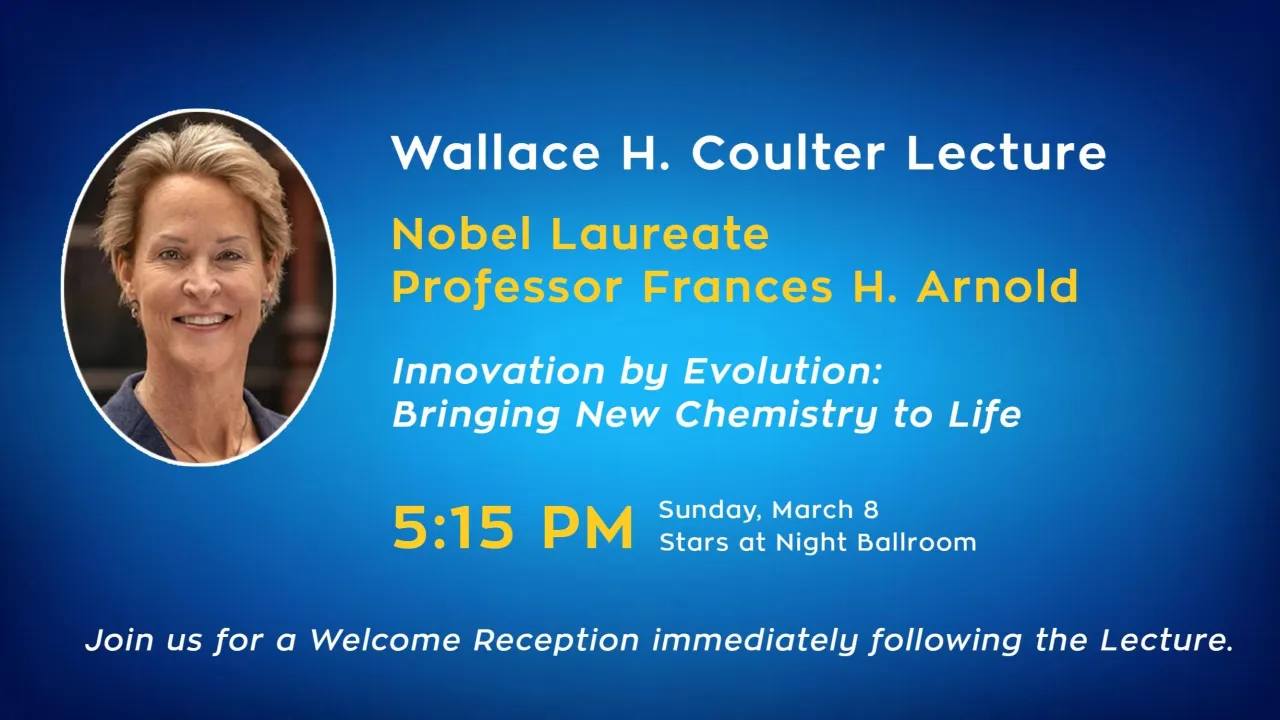
Wallace H. Coulter Lecture: Innovation by Evolution: Bringing New Chemistry to Life
Information
Arnold received a bachelor’s degree in mechanical and aerospace engineering from Princeton University in 1979 and a doctorate in chemical engineering from the University of California at Berkeley in 1985. She spent a year as a postdoctoral fellow at Berkeley before arriving at the California Institute of Technology (Caltech) as a visiting associate. She became an assistant professor in 1987, an associate professor in 1992, and finally a full professor in 1996.
In the late 1980s and early 1990s, research that used enzymes to catalyze chemical reactions was very difficult, because the typical approach involved trying to figure out from first principles how to change an enzyme. Arnold decided to use a different approach, that of evolution. She altered the enyzme subtilisin E, which breaks down the protein casein, so it would work in the solvent dimethylformamide (DMF) instead of in the watery environment of a cell. She introduced many random mutations into the genetic code of bacteria that made subtilisin E, and she introduced her mutated enzymes into an environment that contained both DMF and casein. She selected the new enzyme that was best at breaking down casein in DMF and introduced random mutations into that enzyme. After three such generations, she ended up with a mutated subtilisin E that was 256 times better at breaking down casein in DMF than the original.
Arnold and her coworkers extended the technique of directed enzyme evolution to change enzymes for reactions that no enzyme had catalyzed before. They also evolved enzymes to make substances with bonds that do not occur in biology, such as bonds between carbon and silicon and carbon and boron.
Arnold cofounded two companies based on her work. Gevo, founded in 2005, uses yeast to make isobutanol, which can be used instead of ethanol in making fuel. Provivi, founded in 2013, alters insect pheromones so that pests harmful to crops will be unable to mate with each other.
In addition to the Nobel Prize, Arnold received in 2011 the Charles Stark Draper Prize and the National Medal of Technology and Innovation.