

Bedi Consulting
Innovation in Fit-out, Maintenance & Refurbishment
About this entry
Entry Title
Innovative use of 3D LiDAR & drone photogrammetry for condition assessment of Brunel brick tunnels
Long Description of Entry
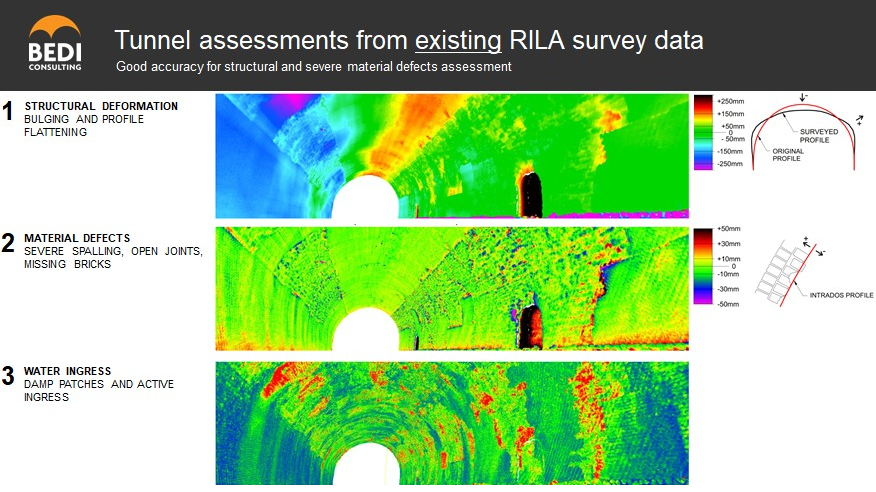
Designed by I. K. Brunel and opened in 1845, Sapperton tunnel is an approximately 2km long brick lined tunnel, which is distorting and deteriorating due to the complex geology in which it was constructed, as well as its age. Sapperton tunnel is a typical example of the over 900 operational tunnels, along 400km of Network Rail's routes, with an average age of approximately 150 years. Given the sheer number of tunnels on the Network and their age, rapid and accurate condition assessment of all these old tunnels is a safety-critical task for Network Rail. Trains operate at speeds in in the order of 100mph through these tunnels, and so debris on the tracks presents a real risk of derailment, as do deflecting tunnel linings into the running clearance of the trains. The main goal of this project was to develop a process that could improve safety through use of new and emerging technologies, and apply them specifically to asset management. With the age of the tunnels and increase in passenger numbers, track access availability is decreasing, meaning possessions to complete tunnel examination and maintenance are at a premium. As the current approach to asset condition assessment is slow and requires a significant amount of ‘boots-on-ballast’ man-power, Network Rail established the need for a new means of qualitative and quantitative assessment methods for masonry lined tunnels major elements, which would allow efficient planning of repairs, so increase safety across the routes. The innovative digital tunnel condition assessment project resulted in development of a novel assessment method and tools that are compliant with the manual visual process set out in Network Rail standard NR/L3/CIV/006/4C and currently in use. This makes it possible to use the new digital method immediately, without changing a tried and tested Network Rail assessment system on which decisions of remedial work are based. Innovative survey, processing, and visualisation techniques provide an assessment method whose key benefits are: Safety: Fewer man-hours on track reduce risk to operatives; surveying from track level minimises the need for high-level access, while providing accurate and photo-realistic data; UAV photogrammetry can replace man-access in shafts or where no safe access can be provided Accuracy: The extent and severity of defective areas can be objectively measured and scored reliably; Planning and costing: Data collection is flexible and less dependent on long or consecutive track access windows; accurate data improves estimate of defects extent and severity, improving costing and quality of estimates. Communication and interoperability: Clear graphical and tabular output improves communication between client and contractor de-risking the works This is the first time digital condition assessment has been used to this extent on a 'live project'. Bedi Consulting & Network Rail working together trialled and developed practical systems to enable existing technologies to be tailored and immediately applied to tunnel condition assessment, and proved incredibly successful on the Sapperton Tunnel trial project. Network Rail now intends to continue using this technology across their assets and see this as the future of undertaking tunnel condition assessments.
About this category
About
This category rewards initiatives that are boosting productivity, safety or quality in the tunnel fit-out process through new products, equipment or methods, and initiatives which are smart ways of maintaining or improving assets via routine maintenance.
The innovative product, equipment or methodology must have been used on a specific project and be able to demonstrate a benefit to the overall project outcome, as well as delivering greater client satisfaction.
This category recognises the inherent value of existing underground infrastructure and work delivered to ensure operational efficiency and maximise the life span of such assets.