

Senceive
Innovation in Instrumentation & Monitoring
About this entry
Entry Title
Transforming tunnel monitoring through long life wireless technology
Long Description of Entry
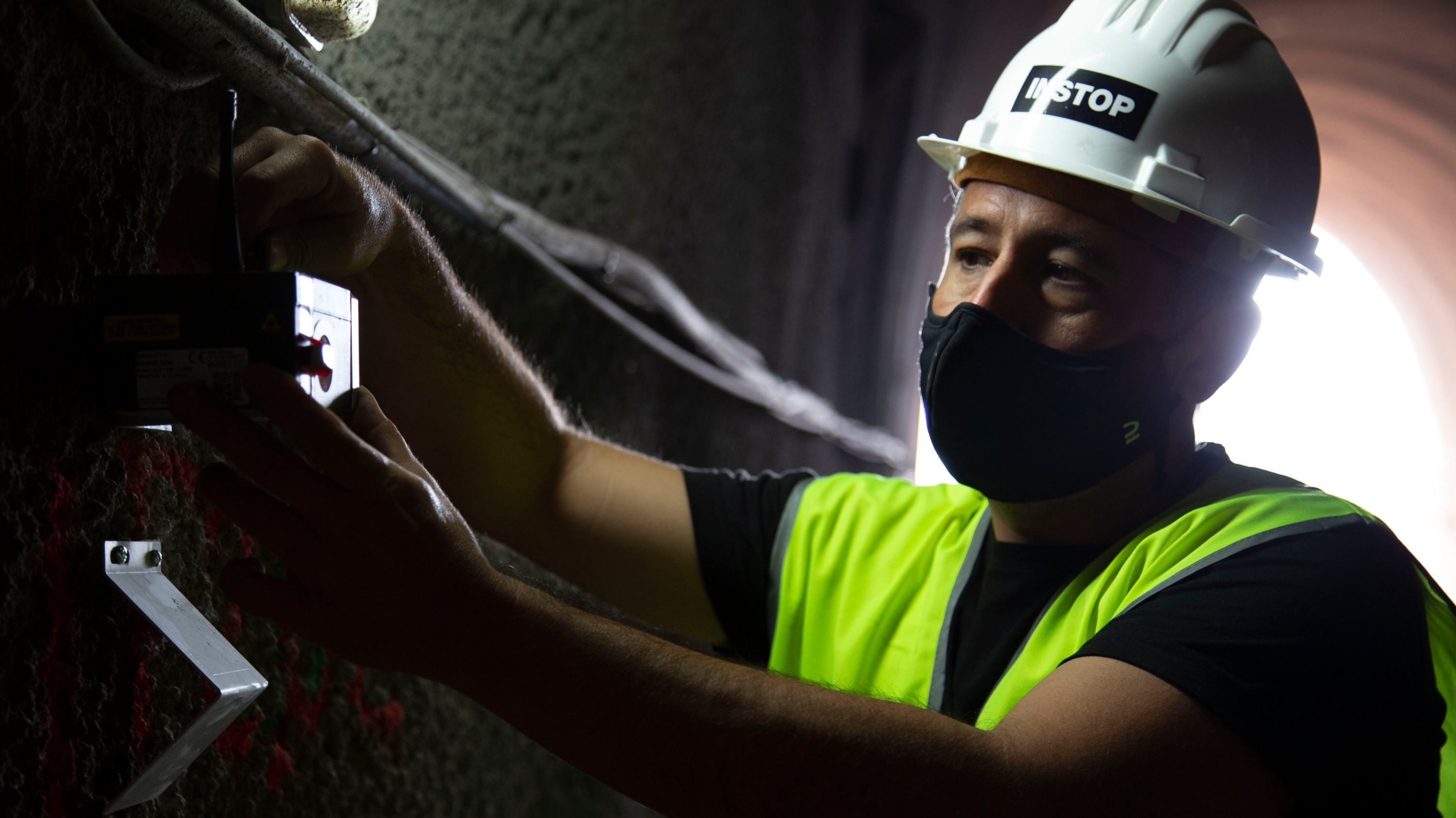
Tunnel construction and modification requires precise measurement of convergence and divergence to safeguard the structure, maintain safety and provide the assurance needed to maintain efficient progress. Established survey methods include manual measurement using tape extensometers and automated methods using laser scanners or automated total stations. Drawbacks include the need for frequent access, power supply, cabling, and cost. Further challenges include highly restricted access to many tunnels, distance from the portal, constraints on physical space and aggressive conditions that can include excessive heat, moisture, vibration, humidity, acidity/alkalinity, dust and combustible gases. Over the last three years, developers at Senceive have designed and built a laser-based optical displacement sensor (ODS) that has changed the tunnel monitoring landscape. Following trial deployments to prove reliability and repeatability it is now possible to monitor tunnel convergence and deformation remotely with a fully automated method that has proven to be robust, repeatable and precise. It is quick and easy to install and to set up, and is not affected by any of the tunnel-related challenges listed above. An array of three ODS sensor and its reflector target can be installed in just 20 minutes and is maintenance free for years. Tunnel movement is measured to sub-millimetre precision with repeatability of ± 0.15mm. Integration of a triaxial tilt sensor allows slope distance to be converted to horizontal and vertical changes, and allows rotational movement to be determined. ODS nodes are connected to a wireless communications network via a solar-powered gateway outside the tunnel, with data instantly transmitted to the internet. Applications include new-build, refurbishment and long-term structural health monitoring. A current project in Spain involves the first large-scale use of optical displacement sensors to monitor deformation in three old masonry tunnel being converted by Dragados for modern high-speed rail use. Modifications including a sprayed concrete lining and track lowering mean there is a need to understand convergence/divergence and settlement/heave. Spanish monitoring specialist Instop considered all options, but challenging site conditions led to rejection of all “conventional” methods. The use of automated total stations was ruled out because construction plant and temporary props would obscure line of site, and very dusty conditions would obscure prisms without frequent cleaning. The absence of a power supply further complicated matters. They therefore selected the new ODS technology from Senceive. In this case a long-range wireless system was chosen because it had the power to relay data from the sensor locations to a solar powered gateway at the tunnel portal with an internet connection. As well as measuring movement at points across the tunnel, longitudinal movement is being monitored using a series of tilt nodes mounted on steel beams fixed to the tunnel sidewalls. The tunnel monitoring system is fully integrated with rod extensometers installed in 6 boreholes above the tunnel to monitor settlement. This integration of methods has enabled main contractor Dragados to remove ballast and lower the track with confidence.
About this category
About
This category recognises innovation and excellence in site surveying and monitoring on tunnelling projects. Entrants to this category must demonstrate and provide evidence to show how, on a specific tunnelling and/or underground project, innovative use of existing instrumentation and monitoring techniques or pioneering new technology is contributing to an improved outcome for the project team and/or client.