High-Performance Computing Workflow for Rapid-Response Physics-Based 3D Earthquake Simulations Integrated In Data Lake
Wednesday, June 24, 2026 3:45 PM to 5:15 PM · 1 hr. 30 min. (Europe/Berlin)
Foyer D-G - 2nd Floor
Women in HPC Poster
Digital Twins and MLGeosciencesPerformance MeasurementStorage Technologies and Architectures
Information
Poster is on display and will be presented at the poster pitch session.
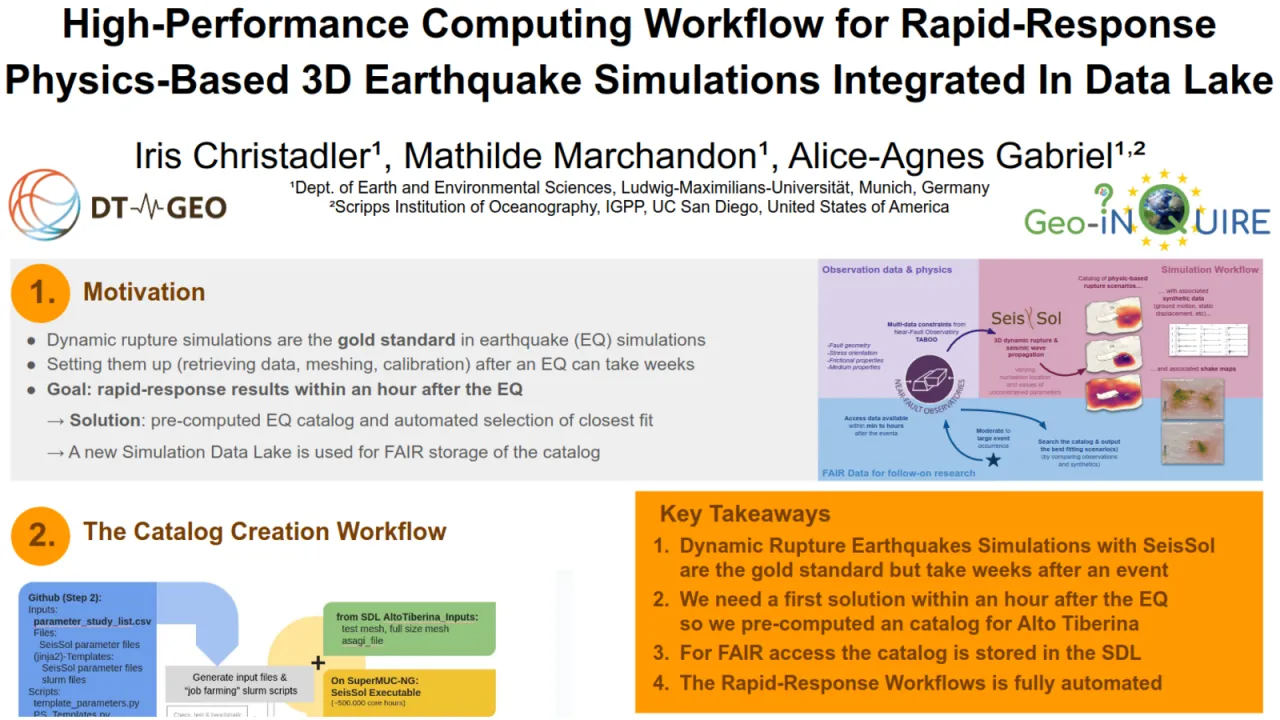
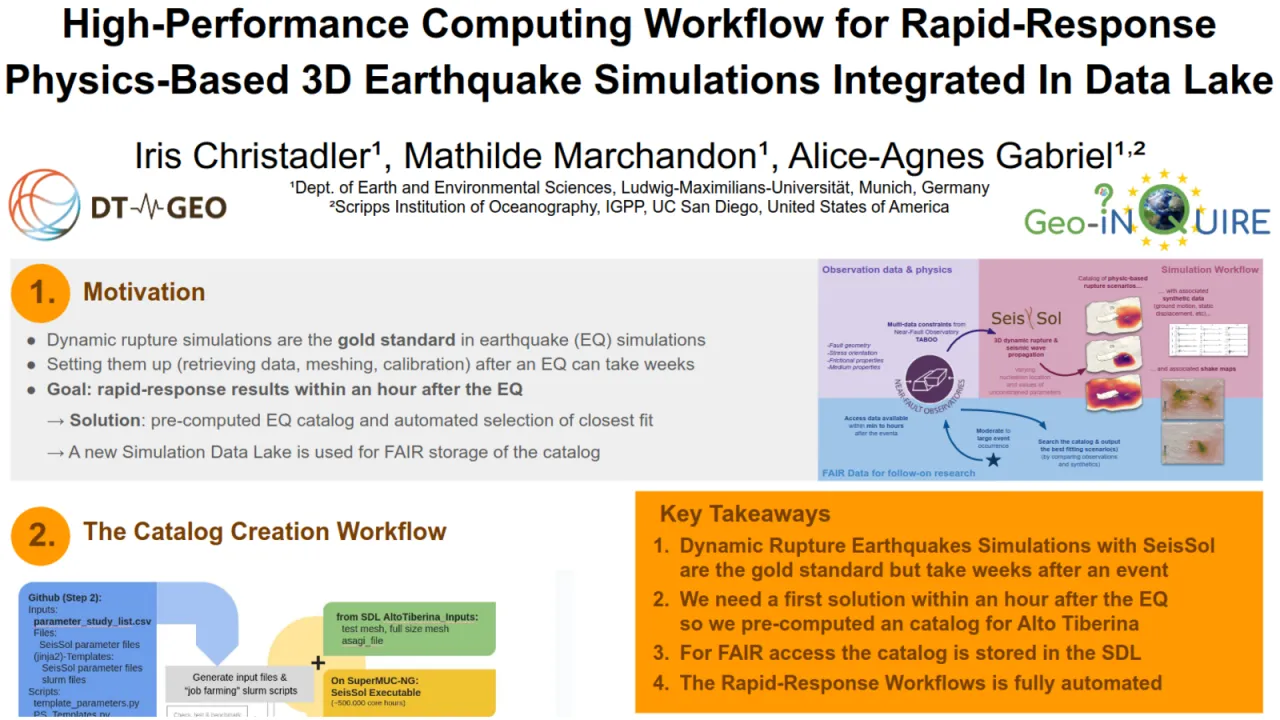
Dynamic rupture simulations are the gold standard in physics-based earthquake simulations and combine modeling seismic wave propagation with non-linear frictional failure of subsurface fault systems. Despite efficient scaling on Tier-0 supercomputers, setting up and running full workflows with high-resolution simulations after a major earthquake can take weeks to months. We introduce a rapid-response workflow that leverages a precomputed scenario catalog generated with SeisSol (500,000 core-hours on SuperMUC-NG@LRZ) for Alto Tiberina, Italy. Our workflow could be triggered when a major earthquake strikes; it rapidly queries the SeisSol catalog by comparing observations with precomputed synthetic seismograms. This process identifies the most representative scenario and provides precomputed shake maps, accelerating this DT-Geo "digital twin component" to less than 15 minutes.
The research data management of extensive parameter studies is complex, and the deployment of efficient storage solutions is increasingly important to avoid losing expensive research datasets.
Several HPC Centers and Research Infrastructures are investing in storage solutions for simulation data. We integrated this workflow into CINECA's new Simulation Data Lake (SDL), offered through Geo-INQUIRE to Earth scientists in Europe. The SDL relies on a comprehensive metadata scheme that enables the storage of a wide variety of data and is already prepared to be integrated within the EPOS data portal. We provide a set of typical SeisSol files to benchmark data up- and downloading to the SDL. All catalog data, synthetic seismograms, and corresponding shake maps are shared FAIR-compliant through the SDL and will be accessible to CINECA’s AI Factory.
Our open-source workflow, data, and code are freely available and can be easily adapted to additional regions or alternative earthquake simulation software.
Contributors:
Dynamic rupture simulations are the gold standard in physics-based earthquake simulations and combine modeling seismic wave propagation with non-linear frictional failure of subsurface fault systems. Despite efficient scaling on Tier-0 supercomputers, setting up and running full workflows with high-resolution simulations after a major earthquake can take weeks to months. We introduce a rapid-response workflow that leverages a precomputed scenario catalog generated with SeisSol (500,000 core-hours on SuperMUC-NG@LRZ) for Alto Tiberina, Italy. Our workflow could be triggered when a major earthquake strikes; it rapidly queries the SeisSol catalog by comparing observations with precomputed synthetic seismograms. This process identifies the most representative scenario and provides precomputed shake maps, accelerating this DT-Geo "digital twin component" to less than 15 minutes.
The research data management of extensive parameter studies is complex, and the deployment of efficient storage solutions is increasingly important to avoid losing expensive research datasets.
Several HPC Centers and Research Infrastructures are investing in storage solutions for simulation data. We integrated this workflow into CINECA's new Simulation Data Lake (SDL), offered through Geo-INQUIRE to Earth scientists in Europe. The SDL relies on a comprehensive metadata scheme that enables the storage of a wide variety of data and is already prepared to be integrated within the EPOS data portal. We provide a set of typical SeisSol files to benchmark data up- and downloading to the SDL. All catalog data, synthetic seismograms, and corresponding shake maps are shared FAIR-compliant through the SDL and will be accessible to CINECA’s AI Factory.
Our open-source workflow, data, and code are freely available and can be easily adapted to additional regions or alternative earthquake simulation software.
Contributors:
Format
on-demandon-site